In 1914, rough synthetic ruby fell from 40 to 50 francs a carat to 12 to 15 centimes. Production cost: about 4 centimes. That history matters when you compare natural vs lab grown diamonds price today, because one Antwerp dealer says the gap is still widening.
What can a 1914 ruby teach a diamond shopper?
Quite a lot, as it turns out. Rapaport's history of "scientific" ruby describes a French popular-science magazine reporting that factories were turning out 40 to 50 kilograms of synthetic ruby a day by April 1914. Rough had dropped from 40 to 50 francs a carat to 12 to 15 centimes, against a production cost of about 4 centimes. Cut synthetic ruby sold for around 2.50 francs a carat.
By my own arithmetic that's a fall of well over 99 percent. Notice where the price landed, too. It sank toward what it cost to make the stuff.
The lesson this series draws is that natural rubies kept their value because they were scarce, while the lab-made ones became cheap. I should be honest here. The excerpt in my notes stops before the natural-ruby ending, so treat that as the lesson, not a measured result with figures behind it. And diamonds aren't rubies. My notes don't give a production cost for lab-grown diamonds, so I can't tell you where their price will bottom out.
What I can do is lay out the two stones side by side on four things: price per carat, grading reports, resale and scarcity. (A carat is a unit of weight, about 0.2 grams.) We sell neither type, so I have no horse in this race.
How wide is the gap per carat?
It depends on who's talking, and that's the first thing to know.
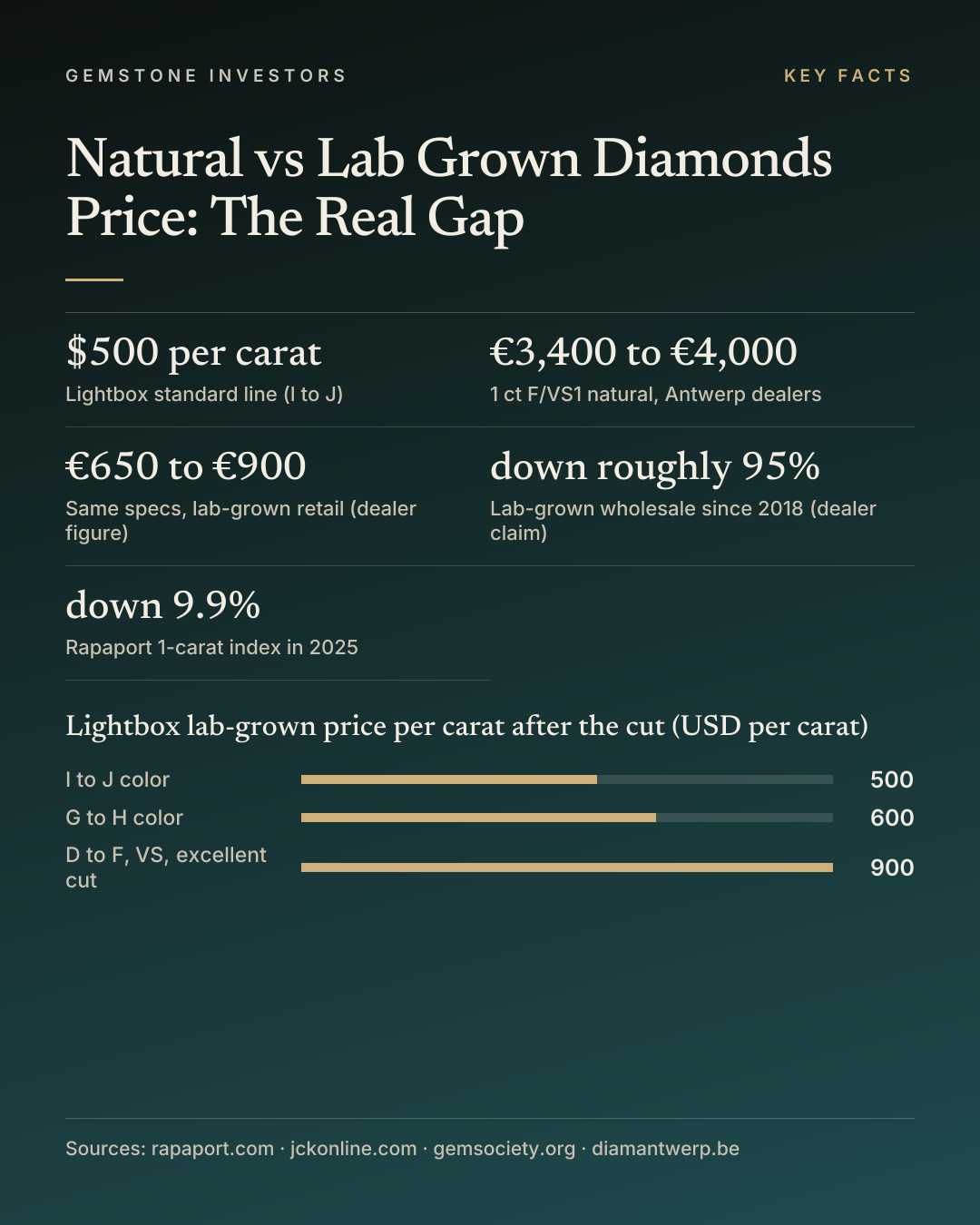
The International Gem Society says lab-grown diamonds can cost 40 to 50% less than natural ones of similar size and quality, with a bigger gap for larger stones and fancy colored diamonds. An Antwerp dealer site, diamantwerp.be, says 60 to 80% less as of 2026. Its example: a 1-carat F/VS1 natural diamond at about €3,400 to €4,000 from Antwerp dealers, against €650 to €900 retail for the lab-grown equivalent.
Treat the dealer numbers as seller estimates. They're plausible, and they're also from someone with stock to move. Another seller-side page I read says only that the gap "varies by stone, retailer, certification, market conditions and date," which is the most honest sentence in the pile.
Some lab-grown sellers publish flat prices, which makes the trend easier to see. When De Beers launched its Lightbox brand in 2018, it charged a fixed $800 per carat regardless of size. That was new, because lab-grown sellers had previously priced much like natural diamonds. Then, as Rapaport reported, Lightbox cut its prices for the first time since launch:
- Standard line (I to J color): $500 per carat
- G to H color: $600 per carat, down 25%
- D to F color, VS clarity, excellent cut: $900 per carat, down 40% from $1,500
Rapaport notes that many in the industry viewed Lightbox as overpriced. Think about that. The brand that cut the price to $800 in 2018 later got called expensive.
If you want a "natural vs lab grown diamonds price chart" with live dollar figures for both, my notes don't have matching US natural prices, so I won't fake one. The euro figures above are the closest honest pair I have.
Did natural diamond prices hold up?
Not as neatly as the sales pages suggest.
Rapaport is blunt: natural prices have fallen, too, and anyone selling natural diamonds as an automatic investment is misleading buyers. Its 1-carat Trade Diamond Index (the average asking price of the cheapest 10% of GIA-graded, high-quality round stones in top color and clarity categories) fell 9.9% in 2025. The 0.30- and 0.50-carat indices dropped 20.3% and 26%. Round 1-carat SI stones lost 24.1%. Three-carat goods were essentially flat.
At the mine end, De Beers' average rough price index was 16% lower year on year in the first half of 2026, a figure that includes its 2025 inventory rebalancing. Within the half, the company described the index as stable.
Now compare that with the Antwerp dealer's table, which calls natural prices "broadly stable" at plus 2 to 3% a year. Those two views don't match. They measure different things (a slice of asking prices versus a dealer's retail impression), and I can't tell you which is closer to your own purchase. That's the honest state of the evidence.
Grading reports: same four Cs, different paperwork
Both types are described by the four Cs: color, cut, clarity and carat. The International Gem Society says lab-grown stones are priced on them just as natural ones are.
The reports themselves are drifting apart, though. GIA announced a cheaper, digital-only lab-grown report, due in the first quarter of 2023. It gives the 4Cs but doesn't say whether a stone was grown by CVD or HPHT (the two main growing methods), doesn't flag post-growth color refinements, and has no inclusion plots (the little maps of internal flaws). GIA's reasoning was that there's less consumer or retailer interest in growth method and treatments.
My view: that's a market signal. A lab-grown report is being treated as a lighter product because the stone behind it is cheaper. Fine, but a lighter report also tells you less, so read what's actually on it.
Resale and scarcity: where the gap really bites
This is where the ruby story comes back.
The Antwerp dealer's table says natural diamonds retain value with an active secondary market, while lab-grown resale is very low and hard to do at purchase price. Again, that's a dealer's view, and Rapaport's warning about "automatic investment" applies to the natural side. I'd read it as a comparison of direction, not a promise. If you're weighing a diamond as a store of value, our piece on the resale reality goes deeper, and why investing in rare gemstones can backfire is worth a read too.
Scarcity is the other half. The dealer says manufacturing capacity for lab-grown stones has expanded dramatically, particularly in India and China, pushing wholesale prices down. A 1-carat lab-grown stone that sold for €3,800 wholesale in 2018 now fetches under €200, by the same source. Mining, by contrast, can't scale up on a few months' notice. Scarcity isn't a guarantee of price, as the natural index declines show, but it's a different footing from a factory you can add shifts to.
Even the lab-grown side expects its pricing to change. Andrey Zharkov, former CEO of Alrosa and now head of lab-grown company Ultra C, told a CIBJO webinar that lab-grown diamonds may develop their own price scale within two or three years. For now, he said, most lab-grown sellers still base prices on the Rapaport list. He also said fancy colored lab-grown and natural diamonds can't be compared on price. That's a seller's prediction, so file it as a prediction.
Meanwhile, Olivia Landau, CEO of The Clear Cut, said on a Rapaport podcast that some retailers spread false information about the value of lab-grown diamonds. She added that she doesn't think consumers understand how inexpensive lab-grown diamonds are. Retailers on either side have a story to sell.
The side-by-side
| Criterion | Natural | Lab-grown |
|---|---|---|
| Price, 1 ct F/VS1 (Antwerp dealer, retail) | About €3,400 to €4,000 | About €650 to €900 |
| Stated discount | Not applicable | 40 to 50% (International Gem Society); 60 to 80% (dealer, 2026) |
| Price trend | Mixed: Rapaport shows 2025 declines; dealer says broadly stable | Dealer says wholesale down roughly 95% since 2018 |
| Grading reports | GIA-graded stones feed Rapaport's indices | GIA's newer report omits growth method and inclusion plots |
| Resale | Dealer says active secondary market; Rapaport says not an automatic investment | Dealer says very low and hard at purchase price |
| Supply | Mined; De Beers rough index down 16% in H1 2026 | Capacity expanded sharply in India and China (dealer) |
So which would I put in a ring?
I'm not advising either, and I'm not going to pretend my notes can pick for you. But here's how I'd think about it.
If you want the biggest, best-looking stone for a fixed budget and you see it as jewelry, the lab-grown price per carat is hard to argue with. If you want something mined and scarce, accept that the price can still fall, as Rapaport's numbers show. In both cases, buy for wearing. Don't buy for profit.
One last practical point. If a seller leads with a big "percent cheaper" figure, ask what it's measured against. Size, color and date all move the number.
Quick questions beginners ask
Is a lab-grown diamond the same stone as a natural one? The Antwerp dealer's wording is that it's a real diamond created in a lab. The price gap, not the material, is the main difference in my notes.
How much cheaper is lab-grown? Sources say 40 to 50% (International Gem Society) or 60 to 80% (a dealer). Both are estimates, and the gap changes with size and quality.
Will lab-grown prices keep falling? The ruby history and the 95% wholesale claim point that way, but I have no diamond production cost, so I can't predict a floor.
What about prices in India? My notes have no India-specific figures for natural vs lab-grown diamond price, so I'd rather say nothing than guess.
Infographic: the key facts
Sources and further reading
- Before Lab-Grown Diamonds, There Was ‘Scientific’ Ruby · rapaport.com
- Lab-Grown Diamonds May Develop Their Own Price Scale, Seller Says - JCK · jckonline.com
- Podcast: The Lab-Grown Con? · rapaport.com
- GIA to Offer Cheaper Lab-Grown Report - Rapaport · rapaport.com
- De Beers Reduces Prices of Lightbox Lab-Grown Diamonds · rapaport.com
- Lab-Grown Diamond Pricing - International Gem Society · gemsociety.org
- Lab-Grown vs Natural Diamonds (2026): Price, Value & Truth · diamantwerp.be
- Lab-Grown Vs Natural Diamonds: Price, Quality & Value · diamiv.com