Blue topaz used to be rare, and it commanded a fine price. Then, in the 1960s, a technique arrived that could turn common white topaz blue. According to the Gem Society, the stone suffered a massive loss of value. That's the first lesson in investing in rare gemstones: rarity can evaporate.
Picture someone who bought a blue topaz just before that technique caught on. Pure imagination, but you can feel the sinking stomach. The stone looked exactly the same the morning after the news broke. The market's opinion of it did not.
I love colored gemstones, and I'm not here to scare you off them. I just think beginners deserve the honest version. So here's how prices really work, why comparing two stones is harder than it looks, and where the risks hide.
Why can't I just look up what a ruby costs?
You can look up a number. You just can't trust it to describe your stone.
The International Gem Society publishes a gem price guide, and it's upfront about the catch. When you pick a gemstone, the range shown covers every variation: color grade, clarity grade, origin (where it was mined) and shape. You have to filter down to get anything close to useful. Even then, the guide says colored gemstones vary in price, often from one dealer to the next, so the figures are only a guide.
Now picture the fight beginners love to start: which is worth more, a ruby, a sapphire or an emerald? Sotheby's says flatly that there's no universal ranking. Ruby can reach extraordinary per-carat prices at the very top. But rare Kashmir sapphires and exceptional Colombian emeralds can also fetch huge sums. What matters is the mix of color, natural quality, size and origin in the one stone in front of you.
Sotheby's gives the same advice for comparing colored gemstones with fancy colored diamonds: judge rarity inside each stone's own category first, and only then look at carat weight and price per carat. (A carat is a unit of weight, about 0.2 grams.)
That's a slower way to shop. It's also the only honest one.
What makes one stone worth more than its near-twin?
Start with color. According to the Gemological Institute of America (GIA), color is the most important quality factor for a colored stone that isn't a diamond. Experts look at hue (the basic color), saturation (how strong it is) and tone (how light or dark). The best mix is different for every gem.
GIA adds a few details that surprised me:
- Stones so dark you can barely see through them are harder to sell, and their price usually drops a lot.
- A single pure hue usually beats a mix. An evenly blue sapphire is worth more than one with a secondary green tint.
- Pale colors usually sell cheaply, except when they don't. Pale blue-green "mint" tourmaline from Afghanistan and Pakistan commands much higher prices than its more saturated cousins from the same source.
That last one is a good reminder that gem logic has exceptions, and they can cut either way.
Size matters too, but not in a straight line. Sotheby's notes that fine ruby becomes disproportionately scarce at larger sizes, especially when strong natural color and little or no treatment hold throughout the stone. (Treatment means things like heating a gem to improve its color.) Important Burmese rubies can narrow the field so much that an exceptional one can outprice diamonds from more available fancy-color segments. A seller called The Natural Gem puts it simply: clear red stones of 5 carats and more are "absolute rarities."
Then there's the paperwork-and-pedigree layer. The International Gem Society lists four things that tend to help a piece hold value: verified origin (Kashmir sapphires and Colombian emeralds are its examples), no treatment or at least disclosed treatment, rare colors like padparadscha sapphires or "pigeon's blood" rubies, and craftsmanship from houses like Cartier or Van Cleef & Arpels.
The paraíba story, and why one success isn't a map
Now for a happier tale. Paraíba tourmaline is a copper-bearing tourmaline found in Brazil, Mozambique and Nigeria. Mining began in 1989. A Gem Society writer says its price has been rising for the last 30 years. He recalls making his first paraíba deals in 2012, when prices ran from hundreds of dollars per carat for good stones to $2,000 per carat for high-quality ones. He remembers thinking that was expensive.
It's a great story. It's also one dealer's memory. The notes I have don't include current paraíba prices, so I can't tell you what that same stone costs today or whether the climb continues.
Here's the thing about success stories like this: you hear them because they happened. You don't hear from the people who bought the gem that fizzled. The blue topaz tale is the other half of the ledger. The Gem Society author who told it says that in his experience, hanging on and watching a gem rise is the exception, not the rule. He says sometimes things get even worse.
What do sellers promise, and what can't we confirm?
Plenty of sellers are enthusiastic. The Natural Gem expects ruby prices to rise by an average of 5 to 8 percent a year. One dealer guide says diversified portfolios, spread across sapphires, rubies and "emerging favorites like vivid spinels," tend to show steadier appreciation. The Rare Gemstone Company argues that natural gemstones are finite, big mines are running out and demand will grow as more people want to own them. The Natural Gemstone Company calls gems a "consistent track record of value retention and appreciation."
Read those with a raised eyebrow. These are all businesses that sell gems. None of the notes I'm working from include independent price data, so I can't verify the percentages, and a forecast isn't a promise. A scarcity argument is also a sales pitch: it's true that nobody's making new natural gemstones, but the blue topaz story shows that supply can change in ways nobody expected.
Where the sources do agree is on quality. Sellers and educators alike say a single exceptional, untreated stone tends to beat a pile of mediocre or heavily treated ones. The Natural Gem goes further and says almost all gemstones suit investing only if they're untreated, natural-color, cut stones, usually one carat or bigger, with a certificate from a respected gemological lab. That's a seller's rule of thumb, but it's consistent with everything above.
The quiet problem is getting out
Buying is the fun part. Selling is where beginners get a shock.
The Gem Society's Rule #3 says you need buyers who can sell your gems at retail prices, so they can at least pay you full wholesale prices. Read that twice. It tells you that wholesale and retail aren't the same number, and that your stone has to find someone who knows how to sell it. A second dealer guide names overpaying as the most frequent investor mistake, especially when glamorous retail displays hide inflated prices.
My view, and it's only the blog's view: if you can't picture yourself happily owning the stone for years even if its price never moves, don't buy it as an investment. Buy it because you love it, and treat any gain as a bonus.
Quick answers to common beginner questions
Are gemstones a good investment? The notes disagree, so I can't give you a clean yes. Sellers describe steady growth, while a Gem Society author says rising value is the exception in his experience. Nothing is guaranteed.
What are the best gemstones to invest in? The names that show up are ruby, sapphire, emerald, paraíba tourmaline and spinel. But Sotheby's says there's no universal ranking, and the individual stone matters more than the type.
Do I really need a certificate? For anything expensive, yes. The Natural Gem says investment gems need a certificate from an internationally recognized gemological institute. Treatments should also be disclosed.
How big should a stone be? One seller suggests colored gemstones become interesting as investments from about one carat up. That's a rule of thumb from a seller, not a law.
So where does that leave you?
With a healthy respect for blue topaz, I hope. Gems can be wonderful things to own and, for the rare few, to profit from. But the evidence in front of me says the safe path is slow: learn what makes a stone rare in its own category, insist on an independent lab report, and never spend money you'd miss. If the price goes up, lovely. If it doesn't, you still own something beautiful.
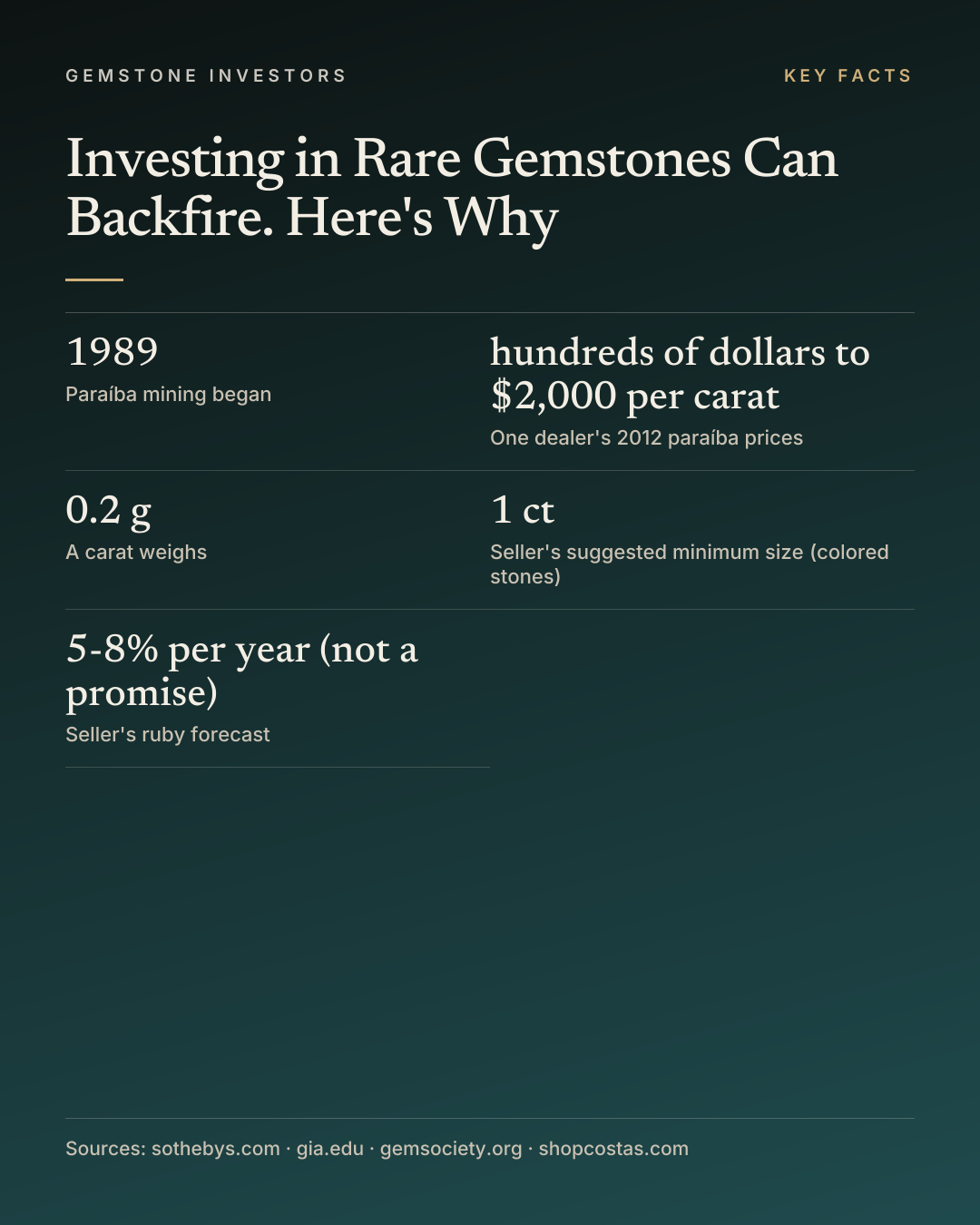
Infographic: the key facts
Sources and further reading
- Colored Gemstones vs Fancy Colored Diamonds: What Collectors Should Know | Jewelry | Sotheby’s · sothebys.com
- Colored Gemstone Value Factors · gia.edu
- Ruby, Sapphire or Emerald? A Collector’s Guide to the “Big Three” Gemstones | Jewelry | Sotheby’s · sothebys.com
- Gem Price Guide - International Gem Society - IGS · gemsociety.org
- Jewelry Investment Pieces: Which Gemstones Hold Value Over Time? - International Gem Society · gemsociety.org
- Making Money Investing in Gems: The Top 5 Rules - Gem Society · gemsociety.org
- Rare Gemstones Investment Guide – What You Should Know · shopcostas.com
- Top 10 Investment Gemstones | The Natural Gem · thenaturalgem.com
- Top Five Gemstone Investments for 2025 - Gem Society · gemsociety.org
- Economic & Investment Benefits | The Natural Gemstone Company · naturalgemstones.com
- Collectors Vault - Extremely Fine, Rare Gemstones for Collectors and Investors · theraregemstonecompany.com