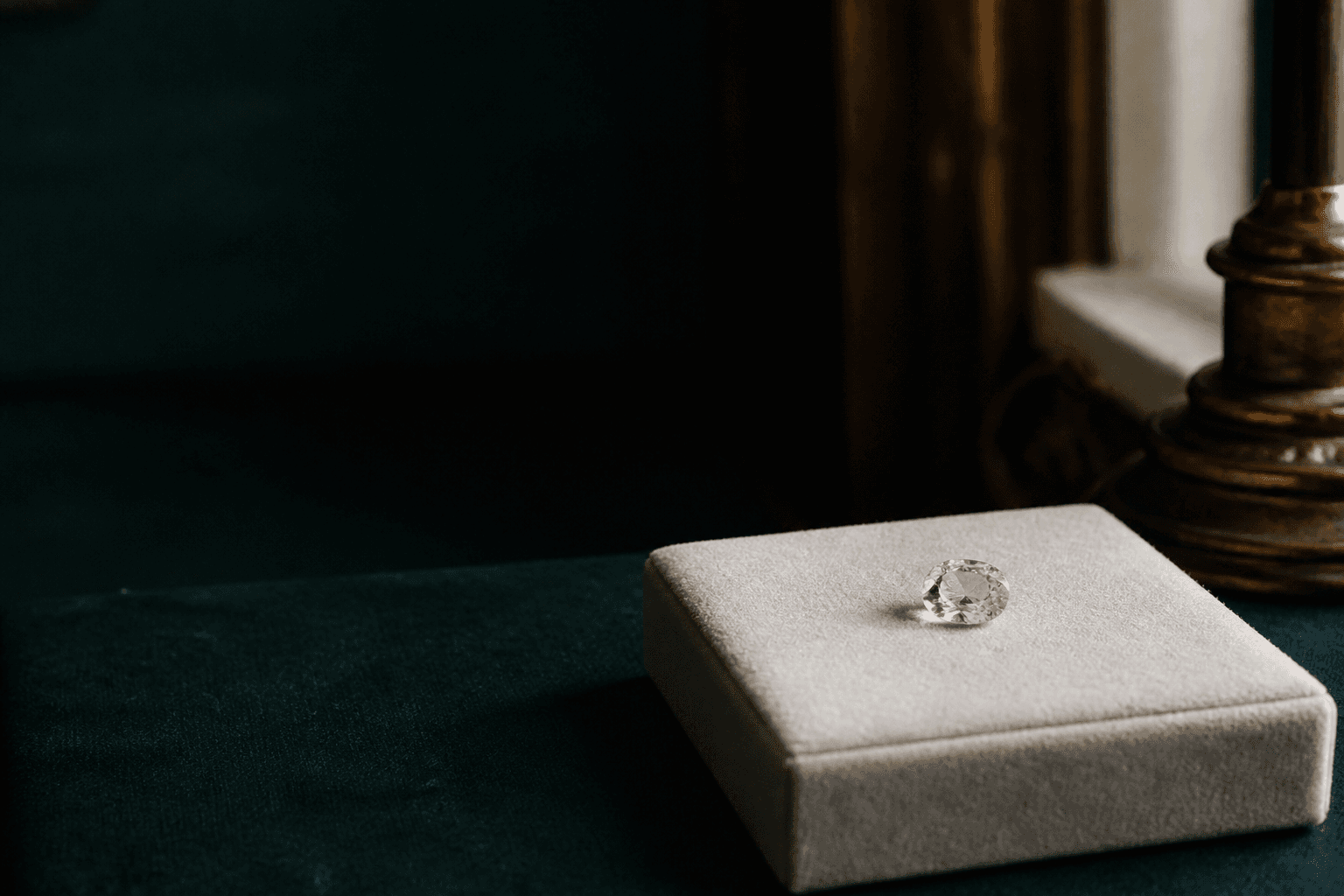
For a stone with no ring, no chain and no setting, someone paid CHF 4,488,000 (about $5.5 million). It closed the Sotheby's Geneva jewelry sale, a $39.8 million night.
That's a lot of money for a loose pebble of pink. But the pink diamond is only the loudest part of the story. The quieter parts tell you more about what collectors want.
So what actually happened in Geneva?
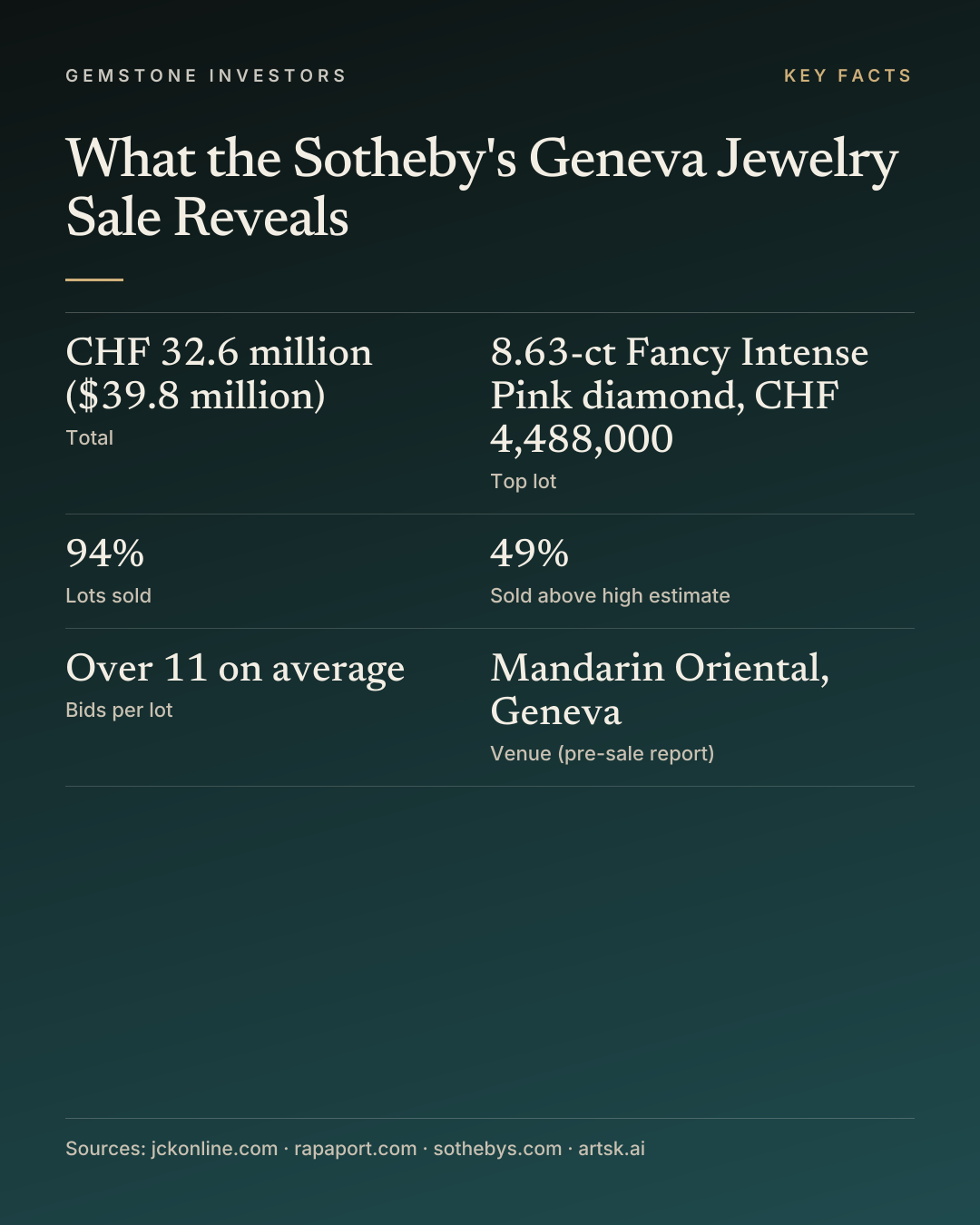
Sotheby's High Jewelry sale brought in CHF 32.6 million, which Forbes reports as $39.8 million. The 8.63-carat Fancy Intense Pink diamond led the way and, according to Forbes, closed the evening. Sotheby's says 94% of lots sold and 49% sold above their high estimates. (The high estimate is the top of the price range the auction house predicts.) There were over 11 bids per lot on average, with strong international participation.
A small wrinkle on dates. Pre-sale coverage from ARTSK puts the sale on November 11 at Geneva's Mandarin Oriental hotel, while Forbes says it closed on November 12. My notes don't explain the gap, so I'm not going to guess.
Why did a loose pink diamond win the night?
"Unmounted" just means the stone isn't set in any jewelry yet. According to Rapaport, it's an oval modified brilliant cut with VS2 clarity. That grade means tiny natural marks you'd struggle to see without magnification. "Fancy Intense" is a color grade. "Fancy" is diamond-speak for "has real color," and "Intense" says how strong that color is.
Before the sale, Sotheby's estimated it at CHF 3.3 to 5 million, or roughly $4 to $6 million, per ARTSK. It sold for CHF 4,488,000. That's inside the range, and a bit above the middle.
Notice what that isn't: a wild bidding war that blew past the forecast. It's a confident, ordinary result for a very rare stone. One caution. Sotheby's results pages say their listed results include the auction house's fees. My notes don't confirm how that applies to every figure quoted in the press, so compare estimates and results loosely, not to the dollar.
What did buyers want besides the big pink?
Forbes sums it up as colored gemstones, historic designs, and pieces with individuality, including Art Deco and colorful pieces. Sotheby's credits sustained demand for rare colored diamonds and gemstones, plus spirited competition for jewels with great design, craftsmanship and history.
Jessica Wyndham, Sotheby's head of high jewelry in Geneva, put it this way in a pre-sale statement: the sale was "defined by rarity, creativity and craftsmanship." She also pointed to jewels "spanning over a century of jewelry excellence." It's marketing language, sure. But the results line up with it.
The same JCK piece lists other color on the menu. A ring with a 5.027-carat "pigeon blood" ruby (a trade term for a prized deep red) was estimated at CHF 850,000 to CHF 1.3 million, or $1 million to $1.5 million. A Harry Winston ring with a 69.44-carat unheated Ceylon sapphire was estimated at CHF 580,000 to CHF 750,000, or $700,000 to $900,000. A Graff ring with a 2.88-carat Fancy Deep Blue diamond carried an estimate of CHF 1.7 to 2.5 million.
Those are estimates. My notes don't give the final prices for them, so I won't pretend to know how they did.
Look at the words buyers were shopping for, though. Unheated. Ceylon, the old name for Sri Lanka. Pigeon blood. Signed by Harry Winston or Graff. Each is a small label that tells you where a stone came from and whether anyone altered it. If those terms are new to you, our heated vs. unheated checklist is a good place to start.
Why would a closed mine matter?
Here's the detail I love. Sotheby's own explainer says pink and red diamonds from the now-closed Argyle Mine can command premiums tied to their origin and increasingly finite supply. A mine shutting its gates can make the leftover stones more precious. Geography usually matters less for fancy colored diamonds, Sotheby's adds, with exceptions like this one. For them, the rarity and quality of the natural color carry far more weight.
Colored gemstones like rubies and sapphires are judged differently. Buyers there look for a specific mix of origin, treatment status and quality. In either category, Sotheby's says a famous maker's name can set a jewel apart from the stone alone.
Does the 8.63-carat pink come from Argyle? My notes don't say. Don't assume it.
Wait, didn't a giant pink get pulled once?
Yes, and it's a good reminder that auctions don't always go to plan. Rapaport reported that Sotheby's withdrew a 10.08-carat Fancy Vivid Pink diamond ring called the Glowing Rose from a Geneva High Jewelry sale. It had been estimated at around $20 million. Sotheby's said only that the lot was withdrawn "following discussions with the consignor." (That's the person selling it.)
Careful, though. That report is undated in my notes and describes a sale with different headline lots, so I can't tie it to this one. The same goes for another Rapaport story, about a 4.50-carat blue diamond, whose sale-wide stats (75% of lots above high estimate) don't match Forbes' 49% for this sale. I've kept those numbers out of the math.
What should a beginner take from all this?
You probably aren't bidding in Geneva. Neither am I. But the same logic works at any price. Rare natural color, a clear story about origin and treatment, and a good maker or design all push value up. Hype mostly doesn't.
If you like colored stones, here's how to read a result like this one.
My take, as the blog's view: the best lesson here is the boring one. Ask what a stone is, where it's from and whether it's been treated before you ask what it's worth. If sapphires are your thing, our Ceylon blue sapphire guide walks through that thinking.
Quick questions beginners ask
Why are the prices in Swiss francs? The sale was in Geneva, Switzerland, and the lot results were given in CHF. Press outlets then converted them to dollars, which is why you'll see both.
Does a $5.5 million result mean pink diamonds always sell this high? No. This is one stone with its own color, size and story. The estimate was CHF 3.3 to 5 million, and it landed inside that range.
Is "unheated" always better? Sotheby's lists it as a key detail for colored gemstones, and buyers clearly care. But my notes don't say it guarantees a higher price in every case. It's one factor next to origin and quality.
Do I need to understand all this to enjoy colored stones? Not at all. You just need to know which questions to ask before you spend.
The sale ended on a pink diamond, but the lesson is in the labels. Learn to read them and you'll understand the next headline too.
Infographic: the key facts
Sources and further reading
- Sotheby's Geneva Sale Led by 8.63-Ct. Pink Diamond That Could Fetch $6M · jckonline.com
- Sotheby’s to Showcase $6M Pink Diamond at Geneva Sale · rapaport.com
- Sotheby’s Withdraws 10ct. Pink Diamond from Geneva Auction · rapaport.com
- Colored Gemstones vs Fancy Colored Diamonds: What Collectors Should Know | Jewelry | Sotheby’s · sothebys.com
- Sotheby’s Geneva Sales Garner $51M · rapaport.com
- CHF 5M pink diamond leads Sotheby's Geneva high jewellery sale on November 11 | ARTSK · artsk.ai
- Sotheby’s Geneva Jewelry Sale Reaches $39.8 Million · forbes.com
- Fine Jewelry | Jewelry | Sotheby's · sothebys.com