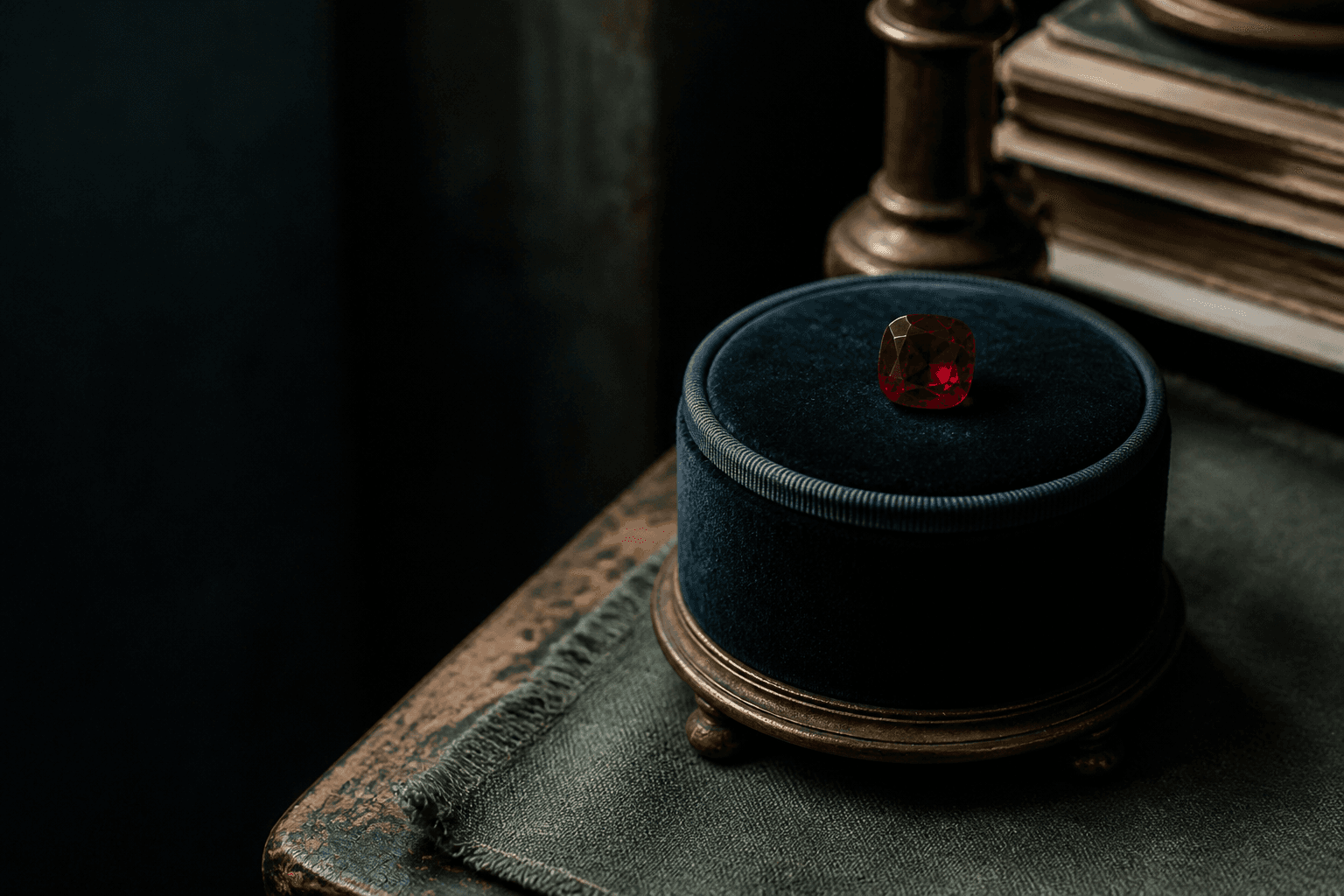
Alisa Moussaieff, 97, paid about $2 million in Geneva on November 12 for a 51.79-carat red stone. Not a ruby. So what is spinel gemstone material, and why did it sell for more than three times its top estimate?
What actually happened in Geneva?
At Sotheby's Geneva high jewelry sale, a cushion-cut (rounded square) spinel from Tanzania went for CHF 1.66 million, which IDEX Online converts to $2.03 million. Its high estimate was CHF 500,000. The stone was unmounted, meaning loose and not set in a ring, and its gemological report showed no indications of treatment.
It was the second most expensive lot of the sale. Only an 8.63-carat Fancy Intense Pink diamond beat it, at CHF 4.49 million.
The buyer renamed it the Moussaieff Spinel, which is her right as the new owner. Yahoo Life UK points out that naming a stone is usually something you see with exceptional diamonds, rubies and sapphires. Spinel just got promoted.
A small honesty note. National Jeweler rounds the price to CHF 1.7 million ($2 million) and lists the estimate as $600,000, while IDEX says $610,000. That's probably just rounding and exchange rates, but it's a good reminder that dollar figures for Swiss francs wobble.
So, what is spinel?
Spinel is its own mineral. It isn't a cousin of ruby wearing a costume, though it has worn that costume plenty of times.
Here's the quick version, mostly from GIA, the big gem-education lab:
- It ranks 8 on the Mohs scale (a 1 to 10 scratch-resistance ranking) and has good toughness, so it suits jewelry.
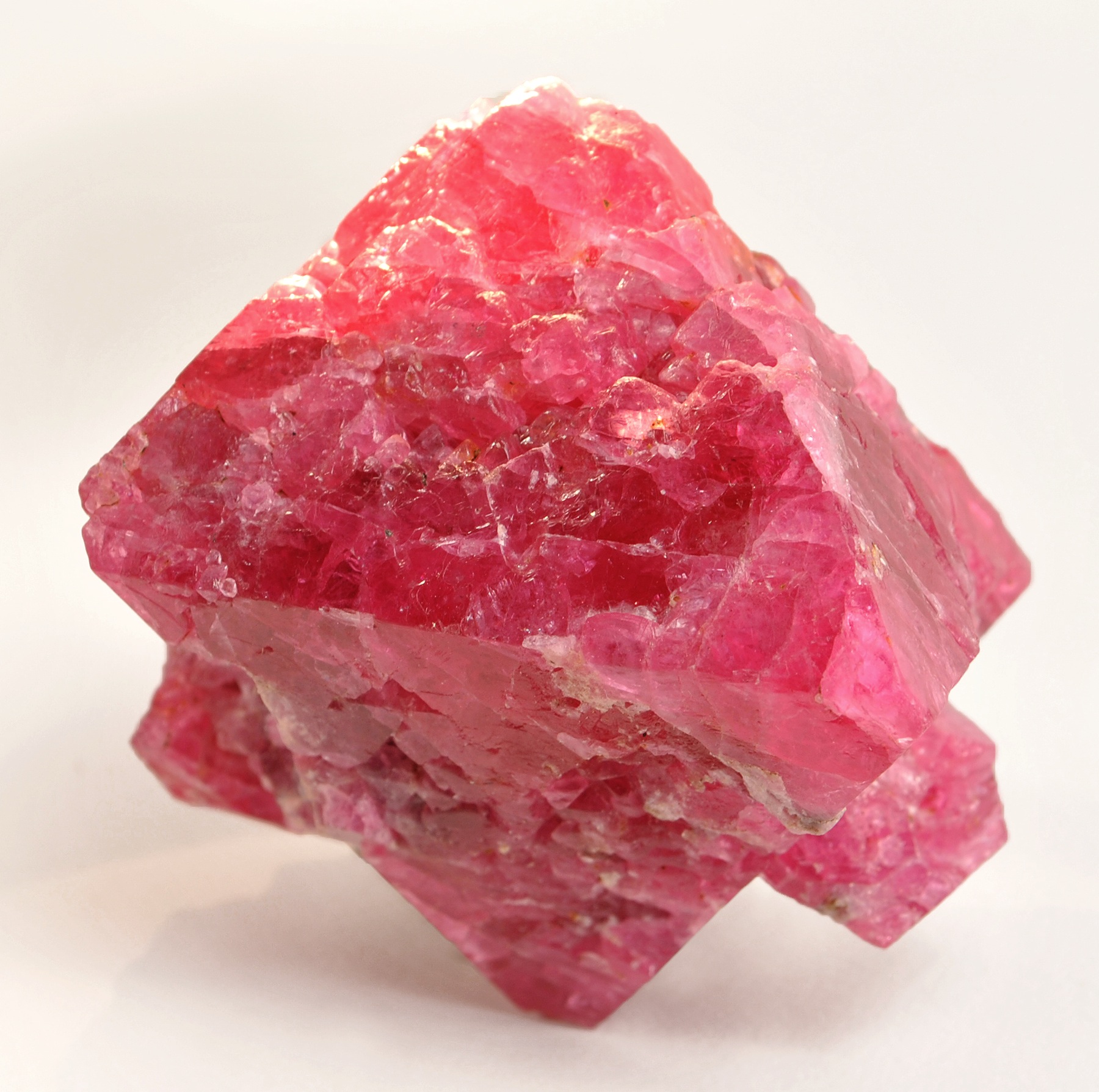
- It belongs to the cubic crystal system, and its typical crystal shape is an octahedron, like two pyramids stuck base to base.
- Red spinel gets its color from traces of chromium, the same coloring agent as in ruby.
- It's often cut in cushion and oval shapes, and GIA says well-proportioned stones have excellent brilliance.
The American Gem Society adds that spinel comes in vivid red, cobalt blue, bright pink, orange, violet, green and more. It also describes spinel as more affordable yet rare. Hold that thought, because $2 million isn't exactly "affordable."
Why did kings keep mistaking it for ruby?
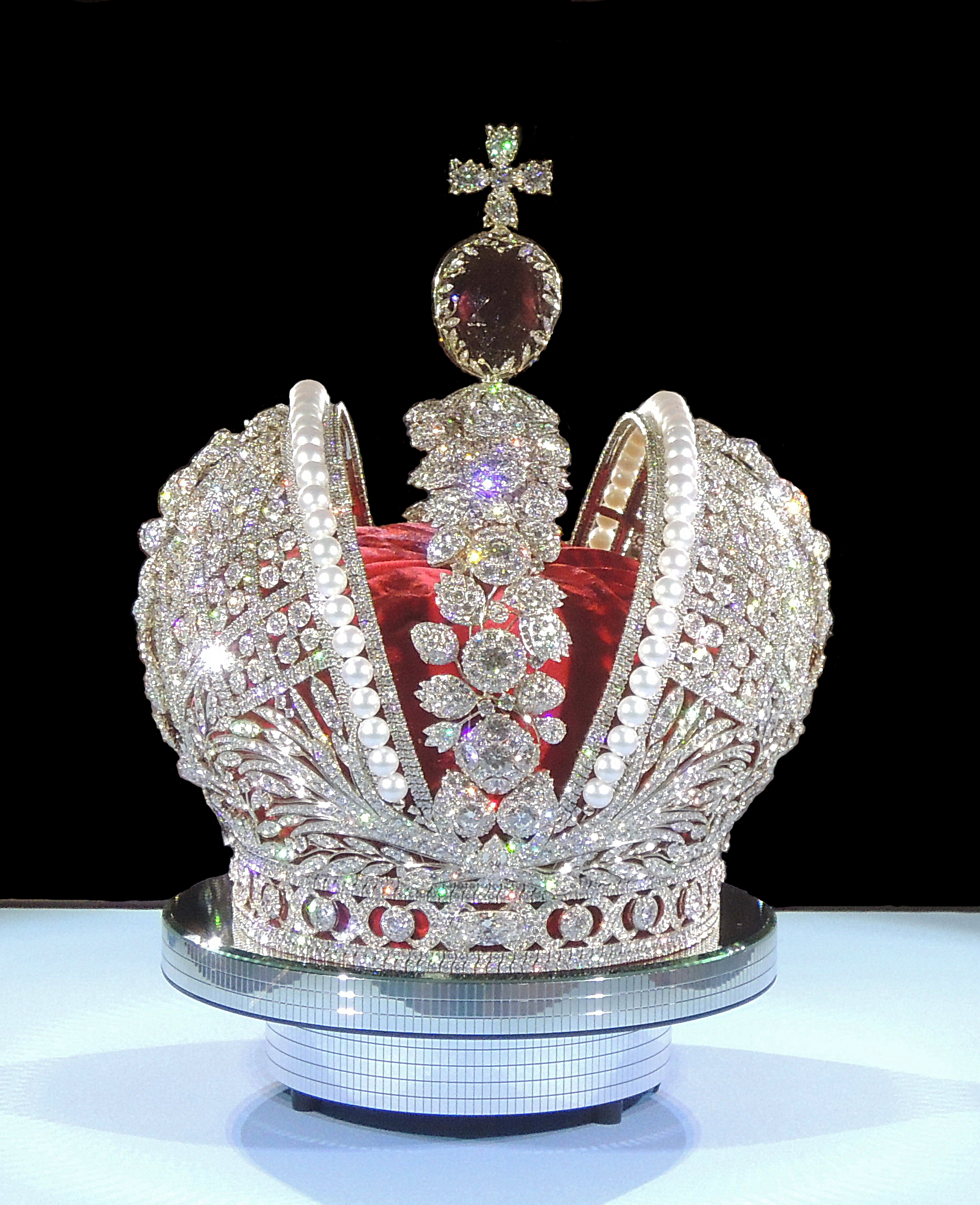
Because it looks the part. GIA calls spinel "the great imposter" and says it masqueraded as ruby in Europe's crown jewels for centuries. The famous 14th century Black Prince's Ruby in the British Imperial Crown is actually a red spinel, according to GIA.
Imagine you're a medieval monarch with a glowing red stone and no lab. You'd call it a ruby too. (Picture this as imaginary, but you get it.)
The AGS says spinel was commonly confused with ruby until 1783. It also says the method of telling the two apart helped give birth to the science of gemology. Not bad for a stone that kept getting the wrong name tag.
In ancient times, GIA says, southeast Asian mines produced exceptional large spinel crystals that became treasures of kings and emperors, often changing hands as spoils of war. In Burma they're said to be nat thwe, "polished by the spirits." I like that a lot.
Moussaieff pointed to this history herself. She said the stone's color "brought to mind the great historic spinel in the British Crown Jewels."
Spinel vs ruby: what's the difference for a beginner?
Both can be a rich red. Both get that red from chromium, and both turn up in alluvial deposits (gem gravel left by rivers). So the differences are subtler.
Per the AGS, spinel has a lower Mohs hardness than ruby and sapphire. It also has single refraction, meaning light travels through it in one direction without splitting. That's a lab-bench clue, not something to test in your kitchen.
For color, GIA says the finest red spinels are pure red to slightly purplish red, medium to medium-dark in tone.
The notes I'm working from don't give a side-by-side price for ruby and spinel, so I won't invent one. What I can say is that the AGS calls spinel more affordable, while this one stone cost $2 million. Size, color and a clean report seem to matter a lot.
Is red spinel value now sky-high?
Not necessarily. One auction is a single data point, not a price list.
Yahoo Life UK calls the sale the "clearest signal yet" that a once-overlooked gem is entering a new era of appreciation. Moussaieff said collectors are looking beyond rubies, sapphires and emeralds as top-quality stones get scarcer. GIA also notes that demand for ruby alternatives has rekindled appreciation for spinel. Those are opinions about a trend, and I'd treat them as such.
This was a 51.79-carat, untreated stone with a story and a famous buyer. Your 2-carat ring spinel is a different animal.
A quick checklist before you fall for a red stone
Quick questions beginners ask
Is spinel a ruby? No. It's a separate mineral, though many "rubies" in royal collections turned out to be spinels, according to GIA.
Is spinel durable enough for a ring? GIA says it ranks 8 on the Mohs scale with good toughness. The AGS calls it a practical choice for everyday jewelry.
What month is spinel the birthstone for? August, alongside peridot and sardonyx.
Is spinel always red? Nope. The AGS lists blue, pink, orange, violet, green, brown, gray and black too.
The takeaway
My view: the Geneva sale is a good reason to learn the name, not a reason to panic-buy. Spinel is a real, durable, beautiful gem with a royal résumé, and it's finally getting credit. If you shop for one, get the lab report, judge the color in good light, and don't let anyone sell you a "ruby" without checking which one it is.
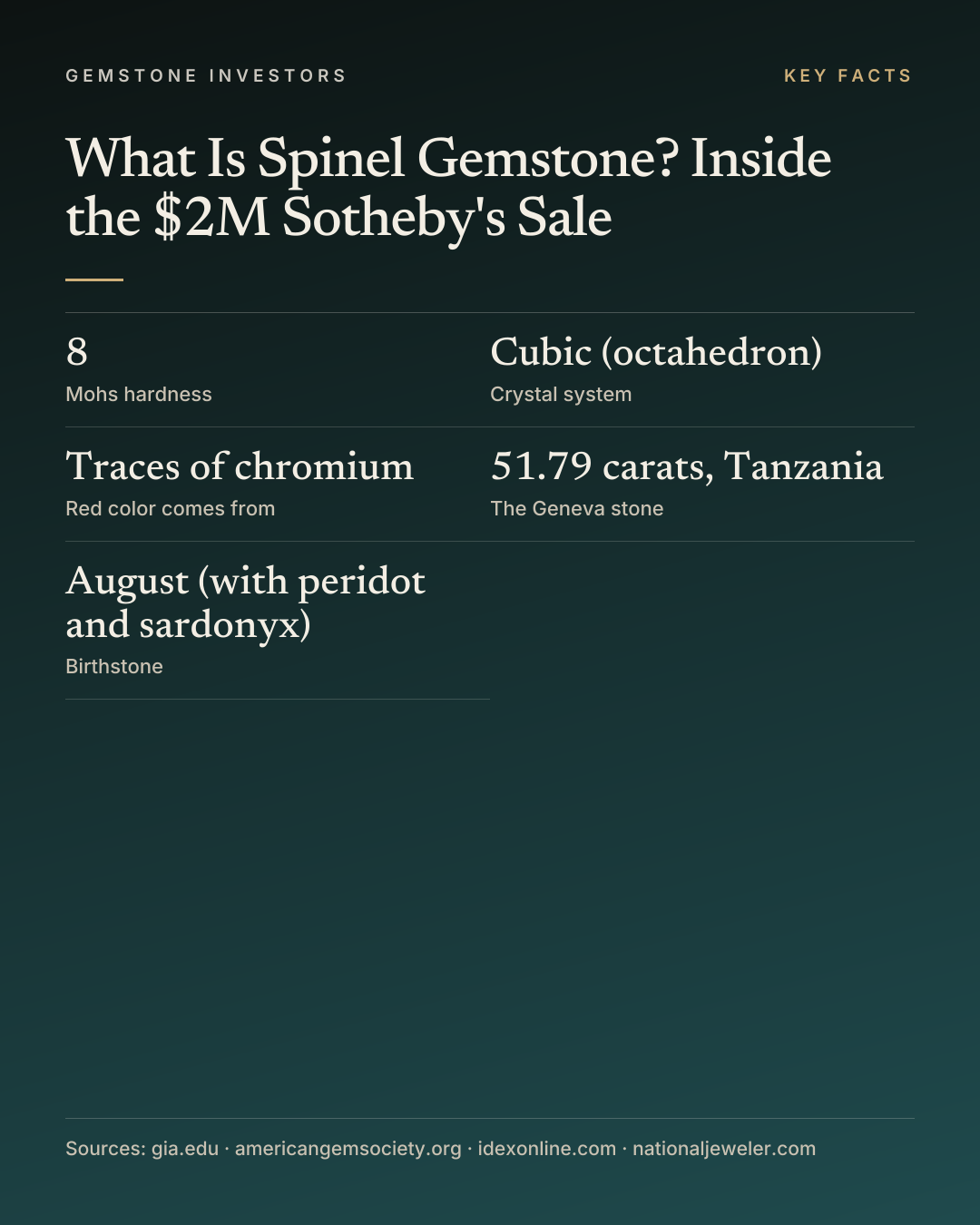
Infographic: the key facts
Sources and further reading
- Spinel Gemstone | Spinel Stone - GIA · gia.edu
- Spinel Gemstone | Spinel Stone - GIA · gia.edu
- August Birthstone: Spinel Gemstone Overview Information · americangemsociety.org
- Spinel Gemstone | Spinel Stone - GIA · gia.edu
- Alisa Moussaieff, 97, Pays $2m for Spinel · idexonline.com
- 52-Carat Red Spinel Sells for $2M to Moussaieff | National Jeweler · nationaljeweler.com
- Spinel is no longer jewellery’s best-kept secret - Yahoo Life UK · uk.style.yahoo.com