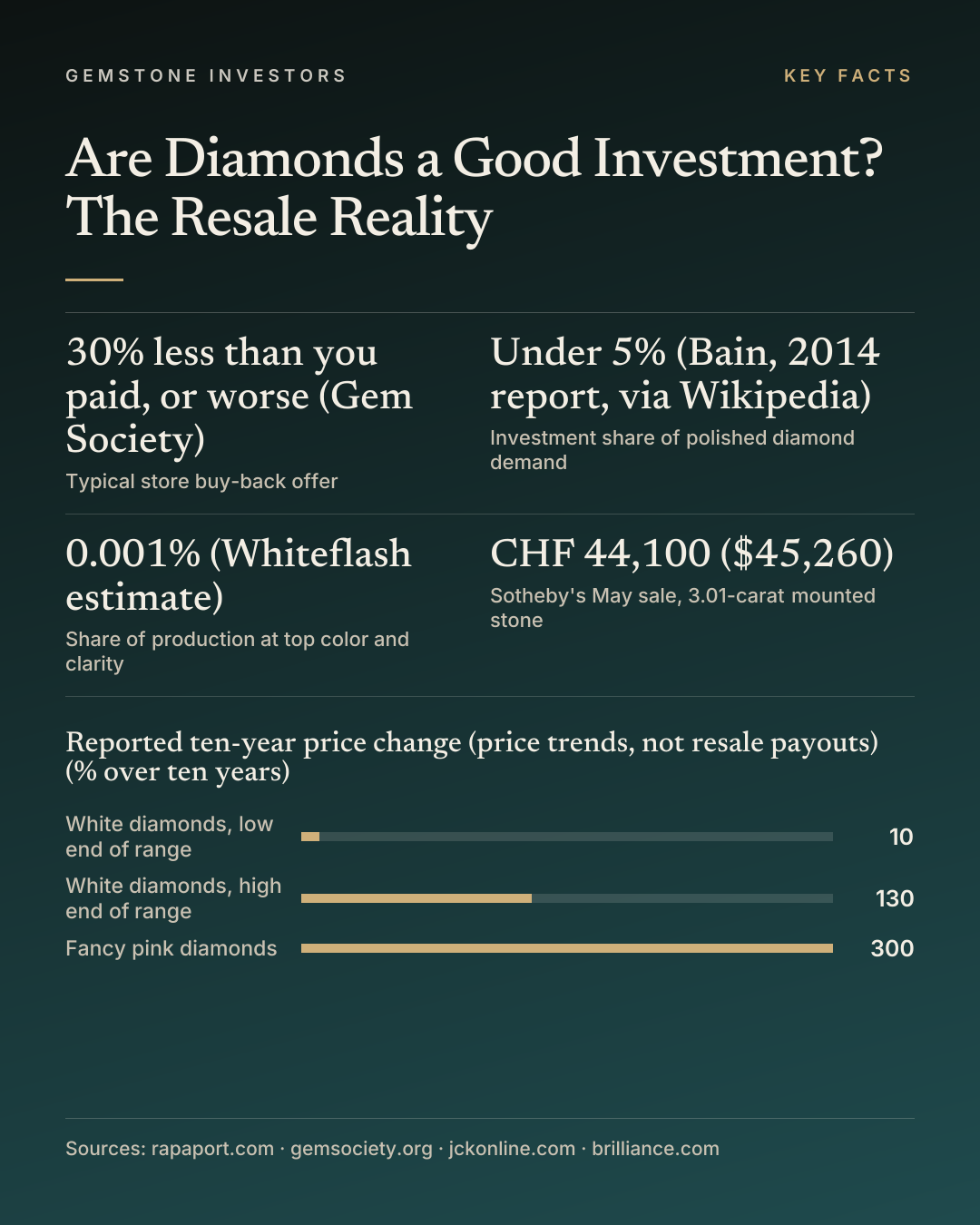
Walk a diamond out of the shop and, according to the International Gem Society, it behaves like a new car: much of its value drops at once. A store's buy-back offer may land 30% below what you paid, or worse. So, are diamonds a good investment?
Step closer to the case. I'll show you the part the sparkle hides.
This is the second look in our diamond investment series, and it covers one narrow, unglamorous question: what's the gap between what buyers pay and what sellers typically receive? I'm working only from the research notes in front of me, so I'll tell you where they agree, where they argue, and where they simply go quiet. I haven't bought, sold or tested a single stone myself, and nothing here is personal financial advice.
Why does a diamond lose value the moment it leaves the case?
Picture a diamond ring under museum lighting. Velvet, glass, a small card with a price on it. Everything about that scene says permanent.
Now picture the same ring on a different counter, years later, with you on the other side.
The Gem Society puts it bluntly: ask a store to buy your diamond back and "you'll probably be disappointed." Offers, it says, would be for 30% less than you paid, or worse. Then comes my favorite line in the whole piece: even if a diamond isn't quite worth what it costs, if you want a diamond, you'll still buy one. That's honest. Wanting is a perfectly good reason to buy. It just isn't the same thing as investing.
Why the discount? A JCK feature on the recycled diamond industry explains it from the jeweler's side. Even retailers with the best intentions generally offer less than wholesale (the price jewelers pay each other). The stone may not sell right away. They'd rather buy from a vendor who can supply exactly what they want. And mounted trade-ins get discounted even more, because a stone sitting in a setting can't be checked closely for flaws.
Here's the sting. According to the same article, many consumers expect prices comparable to retail, never mind wholesale. One person quoted, Montgomery, warns that people who get lowballed "are not going to feel good about diamonds as a store of value."
Let's do some arithmetic, and I'll flag it clearly as imaginary. Say you paid $10,000 for a ring stone. A 30% haircut means a $7,000 offer, and the notes say "or worse." To climb from $7,000 back to $10,000, the value would need to rise by roughly 43%. That's my own math, not a sourced figure, and the $10,000 is made up to keep the numbers tidy. But the shape of the problem is real: a discount of 30% takes a much bigger gain to undo.
Who sets the price when there's no ticker?
Gold has a price you can look up before breakfast. Diamonds don't.
Diamond industry expert Edahn Golan, quoted by Rapaport, says an investable diamond needs buyers and sellers who clearly understand its value at any given time. That trade, he says, "can only happen in a trading environment. This is something that cannot take place in a store." Most of us buy diamonds in stores.
The JCK piece adds that, unlike gold, there's no standardized pricing for diamonds, and prices vary, "sometimes wildly." Some people discover that a decades-old piece has appreciated, to their delight. Not everyone walks away happy.
A second Rapaport article, Valued Assets, gets at the deeper reason. Dana Auslander, founder and CEO of Luxus, says: "Unlike gold, if you break up a diamond, the parts do not equal the whole." Melt a gold bar into two and you still have the same gold. Cut a diamond in two and you've wrecked it. The article also says recent regulatory changes have made it possible to securitize diamonds, meaning turn them into publicly traded assets. It doesn't tell us how that's working out in practice, so I won't guess.
Emmanuel Piat, a gem dealer in Paris, gives the most human summary in the Rapaport notes: "A beautiful stone can always sell but sometimes with little profit and in times of crisis an exceptional stone will always find a buyer even if it may be necessary to concede a loss."
Can sell. Sometimes little profit. May concede a loss. Read it twice.
What does the secondhand counter really look like?
Now let's visit the room most diamond guides skip: the pawn shop and the estate dealer.
Rapaport's piece on pawning diamond jewelry opens with a line that stung me a little. On the secondhand market, natural diamonds "have taken a beating from the influx of synthetics" (lab-grown stones), though they still have value. Dealers weigh market demand, size and quality, the cost of new diamonds, their own inventory needs, and how much cash they have on hand. Susan Eisen, a jeweler and watch dealer in El Paso, Texas, says of those criteria: "That's not something physical that you can look up."
Read that as a buyer. The price you get depends partly on the dealer's cash drawer that day. Charming, in its way. Also a bit alarming.
Size matters a lot. The article says anything 1 carat and larger, especially with a lab report (an independent grading document), can command respectable sums. Small stones are another story. Secondhand melee, the tiny accent diamonds you see lining a ring band, generally doesn't, because it can come chipped and need work before resale. Some shops just pay a low flat fee. Steve Jacobson, owner of Mr. Steve's Pawn Shop in Los Angeles, puts it simply: "Nobody's paying for melee anymore."
Those notes are US-focused, and I have nothing in them on how Canadian or European dealers handle this. I'd expect similar logic, but that's my guess, not a finding.
So why do people keep saying diamonds go up?
Because some of them have. The sources just don't agree on how much it matters to you.
The retailer blog Rare Carat opens with a hedge: "I cannot say that diamonds are a good investment." Then it points to a striking rise in natural fancy colored diamonds (pinks, yellows, blues) over thirty years. It says high-quality white diamonds rose from 10% to 130% over the last ten years, depending on size, and fancy pink diamonds are up 300% over the same period. It also cites one report that high-quality colorless stones of 1 carat and up gained about 12% over the last year. It doesn't say when "the last year" was, so I can't tell you whether it applies to today.
Look at that chart with suspicion, please. It comes from a company that sells diamonds, it shows how prices moved, and it doesn't say what a seller actually received. A price rise on paper isn't cash in hand after a 30% dealer haircut. The range for white stones is also huge (10% to 130%), which tells you size and quality matter enormously.
Meanwhile, another Gem Society article says that, unless you're buying a diamond of exceptional size, white diamonds aren't great investments. Their resale value does increase over time, it says, but it would take a long time to reach the original sticker price. A UK dealer, Quality Diamonds, agrees that diamonds have gone up on the whole, "just very, very slowly," and says a short-term profit is virtually impossible.
Both things can be true. A stone can rise steadily and still fail to beat what you paid at the till.
Rarity is where the exceptions live. The Gem Society's piece on top-grade stones quotes a Whiteflash estimate that only 0.001% of the world's diamond production reaches D color and flawless clarity (the very top of the color and clarity scales). Even so, it says rarity alone doesn't make them good investments.
Auctions show the high end. Rapaport's Valued Assets notes a 3.01-carat mounted stone that sold at Sotheby's in May for CHF 44,100 ($45,260), and a 23.30-carat fancy-yellow diamond ring that brought $327,600 at Christie's in August. Those are real prices for real stones. They're also auction results for specific pieces, which tells you little about the ring in your jewelry box. For a closer look at how a big sale works, see our Sotheby's Geneva jewelry sale breakdown.

Diamonds versus gold: same shelf, different animals?
Searches like "are diamonds a good investment vs gold" and "like gold" come up constantly, so let's be fair to both sides.
For diamonds, the case is real. A diamond is small, portable and easy to store. Brilliance, another seller, says loose diamonds can be a reasonable long-term store of value for buyers who do their research, insist on independent certification and understand the tradeoffs on liquidity (how fast you can turn something into cash). In the same breath it says they're "not a fast or guaranteed path to profit." Larger, higher-grade natural stones have historically appreciated more than smaller, common ones, it adds, though outcomes vary.
Against that, the structural problems. Quality Diamonds notes that gold is valued by weight, while diamonds have no universal price per gram. Each one gets valued on its own merits, and "most of the time, that valuation is somewhat subjective." Brilliance also points out there's no centralized exchange, so finding a buyer who'll pay close to what you paid can take time.
One older number deserves a careful read. Wikipedia's page on diamonds as an investment says that Bain & Co's Global Diamond Report 2014 found demand for investment diamonds made up less than 5% of the total value of polished diamonds. It also says diamond prices had 1.6x lower volatility than gold (they swung less). That report is more than a decade old, and I'm reading it secondhand through Wikipedia. Treat it as a historical snapshot, not a verdict on the market now.
My view, as the blog's view: gold and diamonds solve different problems. Gold is easy to price and easy to sell. A diamond is easy to love and hard to price. If you want something you can sell quickly at a fair, checkable price, a diamond is the harder tool.
What about 2026 and beyond?
Readers ask whether diamonds are a good investment right now, in 2026, or in the future. I can't answer that, and I'd distrust anyone who claims they can.
My notes contain no forecast. No modeled outlook, no stated method, no projection I could check. Every performance figure above is a past trend from a source, and most of those sources are undated, so I can't even say how current they are. The one hard clue about direction is Rapaport's remark that synthetics have hurt natural diamonds on the secondhand market. How that plays out later is unknown. A projection with no method behind it isn't a projection. It's a hope.
What I can say is narrower. Buy-back offers of 30% less or worse come from the Gem Society's guidance, not from a guarantee that every offer will land there. Large, well-documented, high-grade stones appear to hold up better than small ones, according to several sources. And the gap between what you pay and what a dealer offers is the first hurdle any gain has to clear. For more on how that plays out beyond diamonds, our piece on why investing in rare gemstones can backfire covers the wider picture.
A few quick questions
Are diamonds a good investment? The sources lean cautious. Some report price rises, especially for larger stones and fancy colors. But resale offers can come in well below what you paid, there's no standard pricing, and selling can be slow. Rare Carat itself says it can't call diamonds a good investment.
Are diamonds a good investment right now? Most of my notes are undated, so I can't say what's true today. Be wary of anyone who gives you a confident answer.
Are diamonds a good investment like gold? The sources say no, not in the same way. Gold is valued by weight, while each diamond is valued on its own merits, and there's no centralized exchange for diamonds.
What will a jeweler pay for my diamond? It varies. The Gem Society says offers can be 30% less than the purchase price, or worse. JCK adds that mounted trade-ins get discounted even more.
The takeaway from the gallery floor
Buy a diamond because it makes you happy every time the light hits it. That's a fine reason, and the Gem Society says as much. If you also hope it holds some value, treat that as a possible bonus, not a plan.
Before you pay, ask what the shop would give you back. Get a lab report. Expect a slow sale. And if anyone tells you diamonds only go up, ask them for a source, a date and a buyer.
Infographic: the key facts
Sources and further reading
- Investing in Gemstones: A Good Idea? · rapaport.com
- Is a D Color Flawless Diamond Worth the Price? - Gem Society · gemsociety.org
- Valued Assets · rapaport.com
- Is Pawning Your Diamond Jewelry Still Worth It? · rapaport.com
- Diamond Rarity, Quality, and Cost - International Gem Society · gemsociety.org
- Love for Resale: A Look Into the Recycled Diamond Industry - JCK · jckonline.com
- Are Loose Diamonds a Good Investment? · brilliance.com
- The 3 Biggest Mistakes You Can Make When Buying Diamonds as an Investment - and How to Avoid Them | Quality Diamonds · qualitydiamonds.co.uk
- Diamonds as an investment - Wikipedia · en.wikipedia.org
- Are Diamonds A Good Investment | Rare Carat · rarecarat.com